Get exclusive offers, new product updates & helpful resources straight to your inbox.
By subscribing, you agree to our Privacy Policy and consent to receive updates from our company.
Compostable Takeaway Containers: Australian Buyer's Guide
Latest News & Updates
Compostable Takeaway Containers: A Complete Guide to Every Option for Australian Food Businesses
6 November 2026
Compostable takeaway containers are food packaging certified to break down in composting conditions, usually made from sugarcane bagasse, plant fibre or lined paperboard. Choose products certified to AS 4736 for commercial composting, match the material to your menu's heat, grease and liquid load, and check your state's plastic ban rules.
Most owners reach this decision because a state ban or a customer complaint forced it. The risk is not choosing compostable. The risk is buying a container that softens on a delivery run, fails a compliance check or ends up in landfill anyway.
This guide treats compostable packaging as a performance and compliance decision. It sorts the options by material, menu use and disposal pathway so you can order in bulk with confidence. Where a claim needs checking against current government sources, we say so.
Key Takeaways
Compostable, biodegradable and recyclable are three different claims. Only compostable has a certifiable Australian standard behind it.
AS 4736 covers commercial composting. AS 5810 covers home composting. Ask for the certificate, not just a green logo.
Container shape, wall thickness and lid fit cause more failures than the material name does.
A compostable label does not guarantee compliance with your state's plastic ban. Confirm with your state EPA.
Compostable only delivers its environmental benefit if the container reaches a composting facility, so tell customers which bin to use.
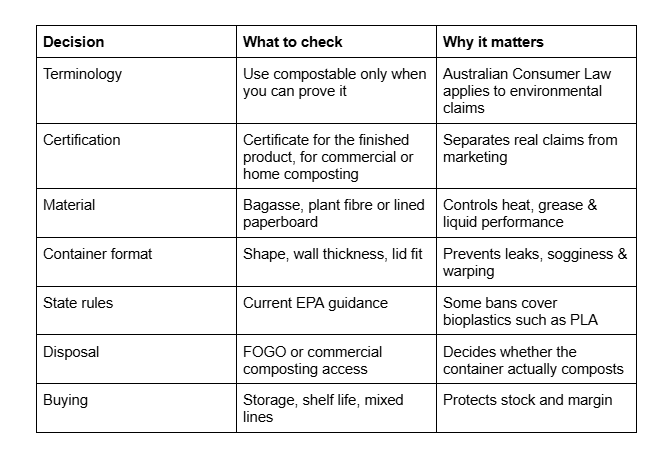
Summary Table
What Does Compostable Actually Mean?
Compostable means a product breaks down into water, carbon dioxide and biomass in a composting environment within a set time, leaving no toxic residue. Biodegradable has no fixed timeframe or conditions, and recyclable means a product can be collected and reprocessed. Under Australian Consumer Law, you can only use these words if you can prove them.
Compostable, biodegradable and recyclable are not interchangeable
Biodegradable is the weakest of the three words. Almost everything biodegrades eventually, including conventional plastic over a very long time. A pack labelled biodegradable with no standard behind it tells you nothing about how or when it breaks down.
Recyclable describes a different pathway entirely. Most food-soiled fibre and bioplastic containers do not suit kerbside recycling, and PLA can contaminate plastic recycling streams. Do not tell customers to put compostable containers in the yellow bin.
Why the wording matters legally
The Australian Competition and Consumer Commission (ACCC) enforces the misleading conduct provisions of the Australian Consumer Law. The ACCC has published guidance for businesses on environmental and sustainability claims. It has also taken action against businesses over vague or unsubstantiated green claims.
The practical lesson is simple. If your menu board, window sticker or website says compostable, you need evidence from your supplier. Keep certificates on file and use the exact wording the certificate supports.
Which Australian Certifications Should You Look For?
Look for AS 4736 for commercial composting and AS 5810 for home composting. Both are Australian Standards for biodegradable plastics. The Australasian Bioplastics Association (ABA) seedling logo shows a product has been independently certified against AS 4736, and a separate home compostable logo covers AS 5810. A certificate number you can verify matters more than any green wording.
AS 4736: commercial composting
AS 4736-2006 is titled Biodegradable plastics suitable for composting and other microbial treatment. It sets requirements for breakdown, disintegration, effects on plant growth and heavy metal limits. Products are tested for industrial composting conditions, which run hotter and more actively managed than a backyard bin.
Most compostable takeaway containers sold in Australia aim for this standard. It is the right benchmark for commercial food service.
AS 5810: home composting
AS 5810-2010 covers biodegradable plastics suitable for home composting. The test conditions are cooler and less controlled, so fewer products pass. Home compostable items are rarer in takeaway packaging because grease-resistant linings are hard to engineer for that standard.
For most takeaway businesses, home compostable is a nice-to-have, not a requirement. Your customers are unlikely to compost a curry container in a backyard bin.
Home compostable vs commercially compostable packaging
Commercially compostable packaging needs the heat and management of an industrial facility. Home compostable packaging breaks down in a backyard bin, but only if it is certified to AS 5810. A product certified to AS 4736 alone should not go in a home compost heap or a worm farm.
This distinction drives your customer messaging. Say commercially compostable on the pack unless you hold the home certificate.
How to check a supplier's claims
Use this checklist before you order:
Ask for the certificate for the specific product code, not the brand or the raw material.
Check that the certificate covers coatings, inks and adhesives, not just the base fibre.
Confirm the issuing body and look the certificate number up with that body.
Ask for a written statement on PFAS. Some grease-resistant fibre products have used PFAS-based treatments, so a PFAS-free declaration is worth requesting.
Check that lids and liners are certified too. A compostable bowl with a conventional plastic lid is not a compostable meal pack.
Which Compostable Material Suits Your Menu?
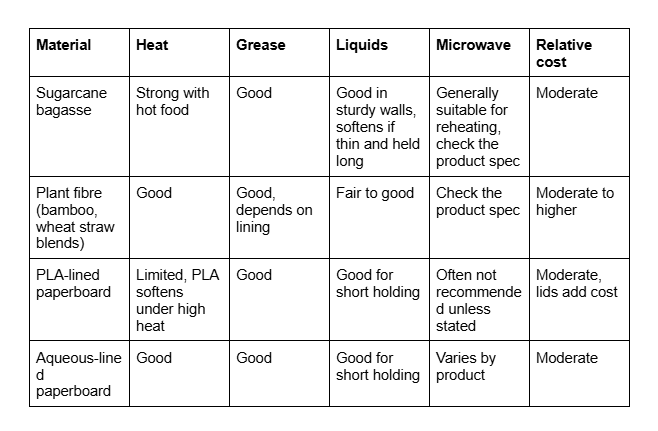
Sugarcane bagasse suits hot, oily and heavy food best, plant-fibre sits close behind, and PLA or aqueous-lined paperboard suits cold food and moderate heat. No single material wins on every measure. Your menu's temperature, grease and liquid content decide which compostable container will hold up through delivery.
The table below is qualitative. Performance varies by wall thickness, manufacturer and lining, so treat it as a screening guide and always test samples.
Sugarcane bagasse containers
Bagasse is the fibre left after sugarcane is crushed for juice. Sugarcane bagasse containers are moulded under heat and pressure into rigid trays, bowls and clamshells. They tolerate hot food, resist grease well and feel sturdy in the hand.
Their weak point is wall thickness. A thin, lightweight bagasse bowl holding a wet curry for a long delivery can soften at the base. Heavier walls and a tight lid solve most of that.
Plant-fibre containers
This group covers moulded products made from bamboo, wheat straw and similar fibres. They behave much like bagasse and often have a slightly different texture or colour. Quality varies widely between manufacturers, so verify certification and test before bulk orders.
PLA-lined and aqueous-lined paperboard
Paperboard containers need a barrier to hold liquids. PLA (polylactic acid) is a plant-based bioplastic lining. It performs well for cold food and warm food, but it softens at high temperatures. PLA also needs industrial composting, so it does not suit a backyard bin.
Aqueous coatings are water-based barriers applied to paperboard. They can handle hot and cold food and are a common alternative to PLA. Ask the supplier whether the finished product, including the coating, holds AS 4736 certification.
A realistic scenario: the curry shop
Consider a curry shop that switches from plastic to thin, lightweight bagasse bowls to meet a state ban. On dine-in orders the bowls hold up. On delivery runs, the oily sauce sits against the base, the bowl softens, and customers complain about leaks and soggy bags.
The fix is not abandoning compostable. The shop moves to a heavier-walled bagasse bowl with a fitted lid for sauce dishes and keeps the lighter bowl for dry sides. The lesson is that specification matters more than material.
How Do You Match the Container to the Menu?
Match the container shape to the food: deep lidded bowls for curries and soups, vented clamshells for burgers, compartment containers for rice meals, and flat plates for dry or buffet food. Shape controls steam, sauce migration and stacking, so it matters as much as material.
Clamshells for burgers and handhelds
A hinged clamshell protects a burger during transport and stacks neatly in a bag. Bagasse clamshells hold heat well, but a fully sealed shell traps steam and softens a bun. Look for designs that vent slightly, or let hot food rest briefly before closing.
Bowls for curries, soups and noodles
Wet, hot food is the hardest test. Choose a heavy-walled bowl with a lid that seals on all sides. For soup, a rigid bowl with a snap-fit lid beats a lightweight paperboard cup. Check the lid is also compostable and rated for hot contents.
Compartment containers for rice meals and bento
Compartments keep sauces from touching crisp items and reduce the need for extra pots. They suit rice bowls, meal-prep and catering. We cover this format in detail in our guide to 2 compartment takeaway containers. Compartment walls are thin points, so test them with your saucier items.
Salads and cold food
Cold food is the easiest to pack compostably. PLA-lined paperboard bowls and clear PLA lids work well for salads, sushi and desserts. Avoid using them for hot food, because PLA softens as temperature rises.
Plates, trays and catering formats
Heavy-duty fibre plates and trays suit events, food trucks and catering. Rigid fibre handles cutting and saucy mains better than thin paper plates. For platters, choose trays with enough rim depth to contain sauce.
Cups and lids
Hot drinks need lined paper cups with compatible lids. Cold drinks and desserts suit PLA cups and domes. Check that cups and lids are certified together, because a lid that is not compostable undermines the whole pack.
What Do State Plastic Bans Mean for Your Packaging?
Single-use plastic regulations are an important consideration for Australian food businesses, with restrictions on various types of disposable food packaging now in place across different states and territories.
These regulations commonly affect products such as plastic straws, cutlery, plates, bowls, expanded polystyrene containers and certain other single-use food packaging items. However, the products covered, exemptions and compliance requirements vary between states and territories, and regulations continue to evolve.
Importantly, compostable packaging is not automatically exempt from plastic bans. Some plant-based plastics, including PLA, may still be classified as plastic under certain state regulations, even when certified compostable.
Before purchasing takeaway packaging, businesses should:
Check their state or territory regulations to confirm which products are permitted or restricted.
Review material requirements, particularly for compostable plastics, bioplastics and plastic-lined paperboard.
Consider product-specific exemptions, as some regulations distinguish between packaging used for food preparation, pre-packaged food and food served directly to customers.
Stay informed about regulatory changes, as additional restrictions may be introduced over time.
For the most accurate and up-to-date information, we recommend consulting your relevant state or territory government's official environmental or single-use plastics website.
Choosing the right takeaway packaging means considering not only performance, sustainability and cost, but also compliance with the regulations applicable to your business.
Where Do Compostable Containers Actually End Up?
Compostable containers only deliver an environmental benefit if they reach a composting facility. Commercial composting access is patchy, FOGO bin rules vary by council, and home compost bins suit only products certified to AS 5810. Tell customers exactly which bin to use, and say so on the pack.
FOGO bins and commercial composting
FOGO stands for Food Organics and Garden Organics. Many councils now collect it, and several states have set targets to expand access. However, councils differ on whether certified compostable packaging is accepted in the bin. Some accept it, some accept only certain items, and some do not accept it at all.
Check your local council's rules. Then check the rules in the suburbs where your customers live, because they are the ones disposing of the pack.
What to tell customers
Keep the message short and honest:
Say commercially compostable, not just compostable, unless you hold the home certificate.
Say where to put it: your council's FOGO bin if accepted, otherwise general waste.
Do not tell customers to recycle it.
If you run dine-in, offer a compost bin and arrange a collection service that accepts certified packaging.
Being upfront also protects you under Australian Consumer Law. Overpromising disposal outcomes is the easiest way to turn a good packaging choice into a complaint.
How Should You Buy Compostable Containers in Bulk?
Buy compostable containers in bulk when you have confirmed the product works on your menu, have dry storage space, and can use stock within its recommended shelf life. Mix compostable and conventional lines where a compostable option fails a specific job, such as very wet or very hot food.
Storage and shelf life
Fibre and PLA products are sensitive to moisture and heat. Store cartons off the floor in a cool, dry area away from direct sun and steam. A hot storeroom or a food truck cab can soften PLA items and warp lids.
Shelf life varies by product and coating. Ask your supplier for the recommended storage period in writing and rotate stock first in, first out. Do not stockpile more than you can use inside that window.
Cost: compare the whole job
Compostable containers typically cost more per unit than basic plastic. Compare the true cost instead. Include remade orders, refunds, leaks and the cost of lost reviews. A slightly pricier heavy-walled bowl can be cheaper than a thin one that fails on delivery.
When to mix compostable and conventional lines
A mixed approach is sensible when:
A specific item, such as a very oily or very hot dish, fails every compostable sample you test.
Your state allows a conventional option for that item.
You want to cut SKUs and keep one reliable lid across several bowl sizes.
Start with your three highest-volume items, switch those first, and expand once they perform. Browse the compostable and eco range at Food Packaging Online, order in bulk for better pricing, and contact the team for help matching containers to your menu.
What Most Guides Miss: Test Like Your Worst Friday Night
The contrarian view I hold is this: the material name on the carton is the least useful thing you will read. Most compostable failures I see discussed by operators trace back to two details, wall thickness and lid fit, not whether the product is bagasse, fibre or lined board.
So test containers the way your worst Friday night will treat them. Fill a sample with your hottest, oiliest or saucier dish. Seal it with the real lid, put it in a delivery bag, stack something heavy on top, and leave it for the length of your longest delivery run. Then check the base for softening, the lid for lift, and the bag for seepage.
I also hold a second, less comfortable position. Compostable is not automatically better for the environment. A compostable container sent to landfill does not deliver its intended benefit. For many businesses, the strongest reason to switch is compliance and customer expectation, with the environmental benefit following only where composting access exists.
That is why the order of decisions matters. Check your state rules, then your disposal pathway, then the material, then test. Reverse that order and you risk buying attractive packaging that leaks or breaches a ban.
FAQs
Are compostable takeaway containers microwave safe?
Often yes for bagasse and plant-fibre containers, but it depends on the specific product. PLA-lined items can soften when heated, so they are often not recommended for the microwave. Check the manufacturer's specification for each product code and test with your own food.
What is the difference between home compostable and commercially compostable packaging?
Commercially compostable packaging is certified to AS 4736 and needs the managed heat of an industrial facility. Home compostable packaging is certified to AS 5810 and breaks down in a backyard bin. Most takeaway packaging is commercially compostable only.
Can I put compostable containers in my FOGO bin?
It depends on your council. Some accept certified compostable packaging in FOGO bins and others do not. Check your council's current rules before telling customers to use the bin.
How do I know a supplier's compostable claim is genuine?
Ask for the certificate for the exact product code, confirm it covers coatings and inks, and verify the certificate number with the issuing body. A genuine claim names the standard, such as AS 4736. A claim that says only eco-friendly or biodegradable is not enough.
Do compostable containers cost more than plastic?
Typically yes per unit, though prices vary by material and volume. The fair comparison includes failed orders, refunds and compliance risk. A sturdier compostable container can cost less overall than a cheap one that leaks.