Get exclusive offers, new product updates & helpful resources straight to your inbox.
By subscribing, you agree to our Privacy Policy and consent to receive updates from our company.
Microwavable Plastic Takeaway Containers | Australian Guide
Latest News & Updates
Microwavable Plastic Takeaway Containers: The Australian Guide to Safe, Reheatable Food Packaging
26 June 2026
Customers who take food home expect to reheat it. That is a basic part of the takeaway experience, and yet a surprising number of operators are still sending meals out in containers that warp, leak or deform the moment a customer puts them in the microwave. The result is a ruined meal, a frustrated customer, and a review you did not want.
Choosing the right microwavable plastic takeaway container is not complicated, but it does require understanding a few material fundamentals. The difference between a container that handles reheating cleanly and one that fails is usually the plastic type, the temperature rating, and whether the lid is designed to vent steam safely. Get those three things right and you give every customer a reliable reheating experience without any extra effort on their part.
This guide is written for Australian cafe owners, takeaway operators, ghost kitchens, caterers, and meal-prep businesses. It covers the materials science in plain language, explains what to look for on labels, walks through the sizes and formats available, compares microwavable plastic against competing packaging options, and gives you practical advice on bulk ordering. By the end, you will have everything you need to make a confident sourcing decision.
Key Takeaways
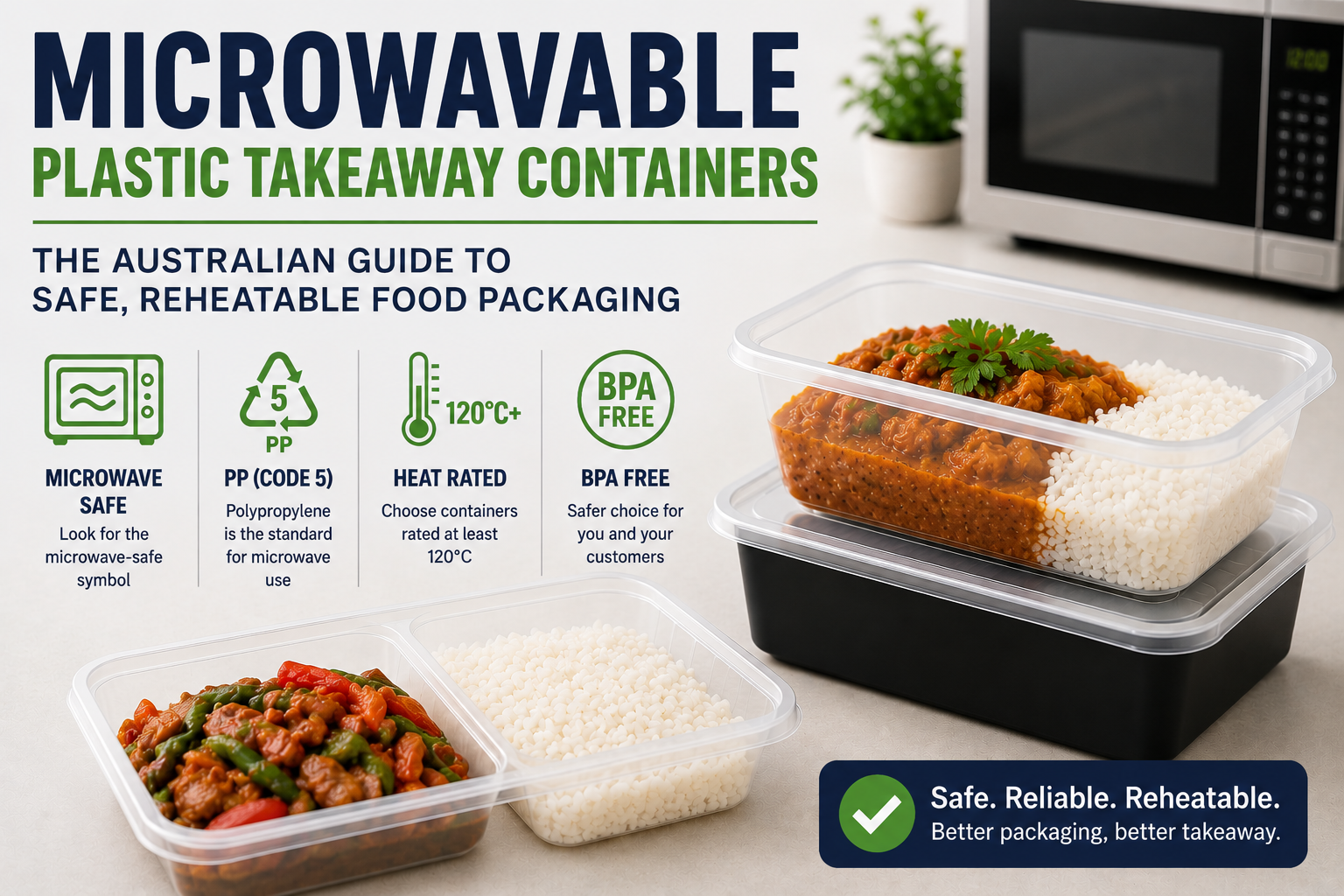
Polypropylene (PP, recycling code 5) is the standard heat-tolerant plastic for microwavable takeaway containers and is the only common single-use plastic consistently rated safe for microwave use.
Look for the microwave-safe symbol (wavy lines) and a stated temperature rating of at least 120°C on any container you intend customers to reheat.
BPA-free labelling matters for food contact safety, particularly for containers used with hot or fatty foods.
Microwavable PP containers outperform paper and compostable options for reheating because they handle moisture and heat without softening or delaminating.
Vented lids are essential for safe microwave reheating; a fully sealed lid can pressurise or cause spillage.
Bulk ordering by carton with matched lids reduces unit cost and ensures a consistent seal across your range.
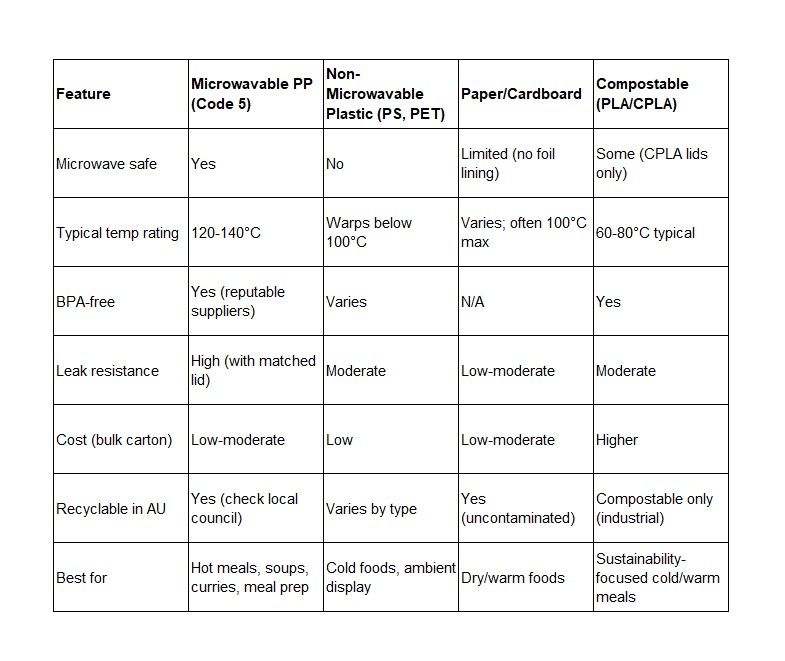
Summary Table: Microwavable Plastic Containers at a Glance
———————————————
What Makes a Takeaway Container Microwavable
The single most important factor in whether a plastic takeaway container is safe to microwave is the resin type. Not all plastics behave the same way under heat, and the differences matter a great deal when a customer is reheating a curry at 800 watts for two minutes.
Polypropylene: The Standard for Microwave-Safe Plastic
Polypropylene, abbreviated PP and identified by recycling code 5, is the material of choice for microwavable food containers. It has a melting point in the range of 160-170°C and a practical heat-deflection temperature well above the typical microwave operating range. When used in food-grade containers, PP retains its shape and structural integrity at the temperatures food reaches during normal microwave reheating, generally between 70°C and 100°C internally, with the container surface potentially hitting 110-120°C in a high-powered microwave.
The chemistry also works in PP's favour. Polypropylene is non-polar, which means it does not absorb microwave energy the way water-containing foods do. The food heats; the plastic stays relatively cool. This is why a properly rated PP container feels only slightly warm to the touch after two minutes in the microwave while the food inside is steaming.
Reputable food-grade PP containers are also manufactured without bisphenol A (BPA), a chemical used in some other plastics that has attracted attention from food safety regulators. Food Standards Australia New Zealand (FSANZ) monitors food contact materials, and compliant PP containers sit well within acceptable parameters for food contact use.
Why Other Plastics Fail the Microwave Test
Polystyrene (PS, recycling code 6) is the most common culprit in failed microwave tests. It softens and deforms at temperatures as low as 80-90°C, meaning a container of hot soup can cause visible warping before a customer even puts it in the microwave. Some PS containers also contain styrene monomers, which can migrate into food under heat.
Polyethylene terephthalate (PET, recycling code 1) is used widely for cold drink bottles and salad containers. It handles cold temperatures well and is transparent, which makes it popular for display. But PET is not suitable for microwave reheating. It softens under sustained heat, and certain forms of PET can release compounds when heated repeatedly.
Polylactic acid (PLA), the basis of many compostable containers, has a heat tolerance that varies by formulation but is typically in the range of 50-60°C before it begins to deform. PLA containers are explicitly not suitable for microwave use unless specifically rated otherwise, which the vast majority are not.
The rule of thumb for operators is straightforward: if the container does not clearly state PP (or recycling code 5) and carry a microwave-safe rating, do not market it to customers as reheatable.
Temperature Ratings and What They Mean in Practice
A microwavable PP container will typically carry a stated temperature tolerance of 120°C or higher. Some premium containers are rated to 140°C. These ratings refer to the temperature the container can withstand without deforming, leaching, or losing its structural integrity.
In practical terms, domestic microwave ovens in Australia operate at 600-1200 watts. A standard 800-watt microwave reheating a 500ml portion of pasta for two to three minutes will bring the food to around 70-80°C. The container surface may reach 100-110°C in localised hot spots. A container rated to 120°C handles this comfortably. One rated below 100°C does not.
For operators running commercial kitchens or producing meal-prep products, it is worth confirming temperature ratings with your supplier before ordering at scale, particularly if you package high-fat or high-sugar meals. Fatty foods and sugary sauces can reach higher temperatures in the microwave than water-based dishes and create localised heat spikes in the container.
———————————————
How to Read the Labels: Symbols, Ratings, and BPA-Free Claims
Labels on takeaway containers carry more useful information than most operators realise. Knowing what to look for saves you from sourcing errors and gives you something concrete to communicate to customers.
The Microwave-Safe Symbol
The universally recognised microwave-safe symbol is a series of wavy horizontal lines, usually appearing inside or beside an icon of a microwave oven. This symbol indicates the container has been tested and rated for microwave use by the manufacturer. It does not guarantee the container will perform perfectly under all conditions, but it is the baseline standard you should require.
If a container lacks this symbol, do not assume it is safe to microwave. Absence of the symbol typically means the product has not been rated or tested for that use.
The Recycling Code
The recycling code is stamped on the base of the container inside a triangle of arrows. For microwavable containers, this number should be 5 (PP). If you see a 1 (PET), 6 (PS), or any other number, the container is not designed for microwave use. This is the fastest field check you can do when assessing an unfamiliar product.
BPA-Free Claims
BPA-free labelling has become standard on reputable food-grade PP containers. BPA (bisphenol A) is a chemical used in polycarbonate plastics and some epoxy resins, not typically in PP itself. However, some lower-quality containers may use fillers or colourants that introduce unwanted compounds. Sourcing from suppliers who explicitly certify BPA-free materials gives you a defensible position with customers who ask about food safety.
It is worth noting that FSANZ regulates food contact materials in Australia and sets maximum permitted migration levels for substances from packaging into food. A BPA-free, food-grade PP container from a reputable supplier will comply with these standards. If you are sourcing from overseas manufacturers, ask for compliance documentation referencing relevant Australian or international food contact standards.
What Temperature and Dishwasher Ratings Tell You
Many microwavable PP containers also carry a dishwasher-safe rating, which typically indicates the container can withstand temperatures up to 70-80°C in the dishwasher wash cycle. This is relevant if you are positioning your containers as reusable, a growing expectation in the meal-prep and catering segments. A container that is both microwave-safe and dishwasher-safe becomes genuinely reusable rather than a single-use item, which has sustainability and cost implications for your customers.
Freezer-safe ratings, usually depicted with a snowflake symbol, indicate the container handles sub-zero temperatures without cracking. For meal-prep businesses packaging food for customers to freeze and then reheat, a container that carries microwave-safe, dishwasher-safe and freezer-safe ratings is the most versatile option in the range.
———————————————
Sizes and Shapes: Matching the Container to the Meal
The Australian takeaway market spans an enormous range of cuisines and portion sizes. Choosing the right container format is not just about capacity. It is about how the food travels, how it looks when the customer opens the lid, and how evenly it reheats.
Round Containers
Round PP containers are the classic format for soups, curries, stews, and congee. The shape has a practical heating advantage: microwave energy distributes more evenly in a round container than a rectangular one because there are no corners where energy concentrates. This matters for liquid or semi-liquid dishes where even heating prevents cold spots.
Typical volume ranges for round microwavable containers run from 250ml (a side serve of soup) through 500ml (a main-meal soup or curry) to 750ml and 1 litre options for family or catering portions. Round containers also stack cleanly, which matters when you are counting storage space in a busy commercial kitchen.
Rectangular Containers
Rectangular PP containers are the workhorse format for rice meals, pasta, stir-fries, and anything that benefits from a neat, portion-controlled presentation. They pack efficiently into delivery bags and sit flat in the customer's fridge without wasting space.
Common volumes in rectangular microwavable containers range from 375ml (a smaller rice or noodle serve) through 500ml and 650ml (standard meal sizes) to 1 litre and larger for family packs or catering. Rectangular containers with a flat lid also lend themselves to label application, which is useful for meal-prep businesses that need to display ingredients, allergen information, or heating instructions.
Compartment Containers
Compartment PP containers, sometimes called bento-style or divided containers, have two or three internal sections moulded into the base. These are popular in meal-prep, school catering, and any offering where you want to keep a protein, a carb, and a vegetable separate during transport.
For microwavable compartment containers, confirm that the dividers are the same PP material as the base and rated to the same temperature. Inferior products sometimes use different materials in the dividers that can warp during reheating even when the base is rated PP.
Which Format Suits Which Cuisine
Soups and broths: round containers, 500-750ml, with a snap-lock or clip lid to prevent travel spills.
Curries and stews: round or rectangular, 500-750ml; round preferred for even reheating.
Rice and grain bowls: rectangular, 500-650ml; flat base ensures even rice distribution.
Pasta and noodles: rectangular, 650ml-1 litre; high sides prevent sauce spillage during transport.
Salads with warm components: rectangular with a separate compartment or a two-container system keeps dressing cold while the protein is reheatable.
Meal-prep bulk packs: rectangular 1 litre or larger, with a secure clip lid for stacking in the customer's fridge.
———————————————
Microwavable Plastic vs Other Packaging Options
Operators often ask whether they should switch to paper, compostable, or premium reusable containers. The answer depends on what you are selling, what your customers expect, and what trade-offs you are willing to accept.
Microwavable PP vs Non-Microwavable Plastic
Non-microwavable plastics, primarily PS and PET, are typically cheaper per unit than PP. That cost difference is the main reason some operators still use them. But the maths changes quickly when you factor in customer experience. A customer who ruins a meal because the container warped or leaked in the microwave is unlikely to reorder. The cost of that lost customer relationship exceeds the carton price saving within a very short time.
PET containers have a genuine role in cold applications: salads, sandwiches, ambient desserts, and chilled drinks. Using PET for cold food and PP for hot food is a rational split if you manage two separate container lines. The mistake is using one container type for everything regardless of whether it will be reheated.
Microwavable PP vs Paper Containers
Paper containers, including cardboard boxes and paper-board bowls, have genuine sustainability credentials when they come from responsibly managed forestry. They are also printable, which gives branding flexibility. For dry and moderately moist foods, paper containers work well.
The limitations appear quickly with hot, wet food. Paper containers absorb moisture over time, which weakens the base and can cause leakage during delivery. They are also not reliably microwavable. Many paper containers use a thin plastic or wax coating to resist moisture, and that coating determines whether the container is microwave-safe. Some are, many are not, and the symbol is not always clearly displayed. Even paper containers rated for microwave use do not always hold up to repeated reheating cycles.
For operators selling soups, curries, and rice meals, paper is the riskier choice when reheating performance is part of the customer promise.
Microwavable PP vs Compostable Containers
Compostable containers made from PLA, bagasse (sugarcane fibre), or CPLA have grown in popularity as Australian operators respond to customer pressure around single-use plastics. The sustainability story is real, but there are practical limitations operators need to understand.
Standard PLA containers are not microwave-safe. They begin to deform at temperatures around 50-60°C. CPLA (crystallised PLA), used in some lids, handles slightly higher temperatures but is still not reliably rated for the full microwave reheating cycle a customer might put it through. Bagasse containers can handle moderate oven and microwave temperatures and are a better compostable option for hot food, but they are not airtight and can become soggy with wet foods over time.
Compostable containers also carry a cost premium. In carton pricing, they typically run 30-60% higher than equivalent PP containers. And their end-of-life benefit depends on the customer having access to an industrial composting facility, which is not available in all Australian suburbs.
For operators weighing sustainability, the most practical approach is often to position a reusable, dishwasher-safe PP container as a sustainable choice in itself. A container a customer uses five or ten times before recycling has a lower total environmental impact than a single-use compostable container that ends up in landfill because the customer does not have access to industrial composting. Food businesses interested in a fuller picture of compostable options can explore eco-friendly takeaway containers as a separate category alongside their microwavable range.
———————————————
Best-Practice Usage Tips for Operators and Customers
Choosing the right container is half the job. The other half is making sure customers use it correctly. A well-chosen PP container can still produce a poor reheating outcome if the customer does not know to vent the lid or avoids overheating dense meals.
Lid Venting: The Step Customers Most Often Skip
The single most important reheating instruction you can give customers is to vent the lid before microwaving. A fully sealed PP container creates a pressurised environment as steam builds during heating. In the best case, the lid pops off mid-cycle. In the worst case, hot liquid or food is expelled suddenly when the customer opens a pressurised container.
Most microwavable PP container lids are designed with a venting mechanism. This is typically a small tab or corner that lifts to create an opening, or a central vent button that can be pressed open. When you brief customers on reheating, whether via a printed sticker on the container, a QR code linking to instructions, or a note on your menu, venting the lid is the top priority.
For operators, this also means checking that your lid design actually includes a vent mechanism before purchasing at scale. A PP container rated for microwave use should have this feature. If the lid is a simple snap fit with no vent point, clarify with your supplier whether the container is designed for full reheating or just for keeping food warm for a short period after cooking.
Avoiding Overheating
Microwavable PP containers handle normal domestic reheating cycles well, but sustained overheating at very high power levels can stress any plastic. Advise customers to reheat in intervals: two minutes at 70-80% power, check the food temperature, then continue if needed. This approach heats food more evenly and avoids hot spots in the container.
For fatty or sugary foods like curries with coconut cream or desserts, overheating is a genuine risk because these foods reach higher temperatures than water-based dishes. A reheating guide that specifies lower power settings for high-fat meals is a practical value-add for meal-prep businesses.
Customer Communication Operators Can Use
A simple, laminated reheating guide card inserted in delivery bags, or a printed sticker on the container itself, gives customers the information they need without relying on them to figure it out. Key points to include:
Vent the lid by lifting the corner tab before microwaving.
Reheat at medium power (70-80%) for 2-3 minutes.
Check food temperature before eating; internal temperature should reach at least 75°C.
Allow the container to stand for 60 seconds after removing from the microwave as residual heat continues cooking the food.
Do not microwave if the container is cracked, warped, or discoloured.
This last point matters for operators positioning their containers as reusable. A container that shows signs of physical wear should be replaced. Building this into your customer communication protects both the customer experience and your brand.
Commercial Kitchen Handling
On the operator side, avoid pre-loading containers and storing them near heat sources before sealing. PP containers are robust, but extended exposure to radiant heat from ovens or warmers can pre-stress the material. Fill containers with food that has been cooled to below 60°C before sealing if they are going into a chiller for later delivery. This prevents condensation build-up inside the container and reduces the risk of the lid seal weakening from internal steam pressure.
———————————————
Bulk Buying Guide for Australian Food Businesses
Buying takeaway containers in bulk is straightforward when you know what to look for. The variables that matter are carton quantities, stack height, lid compatibility, and storage logistics.
Ordering by Carton
Microwavable PP containers are typically sold in carton quantities from 500 units depending on size and supplier. Larger cartons reduce unit cost meaningfully. For a business moving through 200 containers per week, buying in cartons of 500 versus cartons of 100 can cut unit cost by 15-25% depending on the supplier. The trade-off is storage space and cash tied up in stock.
For new operators or those trialling a new container format, requesting samples before committing to a full carton is standard practice and any reputable supplier will accommodate this. Confirming that the lid clicks securely, the container holds up to your specific filling temperature, and the printed label adheres cleanly are all things worth verifying on a physical sample rather than discovering mid-service.
Matching Lids to Bases
This is the most common sourcing error in the takeaway container category. Lids and bases from different suppliers or different product lines may appear compatible but produce an insecure seal in practice. An insecure seal means leakage during delivery and a customer complaint.
Always source lids and bases from the same product line, ideally from the same supplier. When ordering, confirm that the lid SKU is the designed match for the base SKU. If your supplier changes their product range and introduces a new base design, retest the lid fit before rolling out the new container across your menu.
For operations running multiple container sizes (for example, a 500ml curry container and a 250ml soup container), keep lid and base pairs clearly separated in your storage area to prevent staff from mismatching during a busy service.
Stacking and Storage Efficiency
PP containers are designed to nest and stack, which is a genuine logistical advantage in a compact commercial kitchen. When assessing a new container, check the stack height per 10 units. A container that stacks 10 units in 15cm of vertical space stores four times as many units in the same shelf space as one that stacks 10 units in 30cm. Stack efficiency directly affects how much storage space you need to hold a week's supply.
Store containers in their cartons in a dry, cool area away from direct sunlight. UV exposure over extended periods can affect the clarity and structural integrity of PP, particularly for clear containers. This is not a concern over normal stock rotation periods of a few weeks, but it matters if you are buying in very large volumes and holding stock for months.
Volume Planning
For a food business scaling up, calculate your average weekly container usage by format (round, rectangular, compartment) and size (500ml, 750ml, 1 litre) before placing your first bulk order. Overstocking a size you rarely use ties up capital and creates storage pressure. Running out of a core size mid-week creates a service problem.
A useful starting point is to order a three-to-four week supply of each size based on your sales mix, then adjust after the first month based on actual usage data. Most Australian packaging suppliers offer ongoing wholesale accounts with regular delivery schedules, which reduces the need to hold large buffer stocks once your demand pattern is established.
———————————————
Choosing the Right Microwavable Container for Your Business
The best microwavable plastic takeaway container for your business is the one that matches your food format, your volume requirements, and your customer expectations, not necessarily the cheapest option per unit or the most environmentally marketed one.
For the majority of Australian takeaway and meal-prep operators, food-grade PP containers with a clear microwave-safe symbol, a BPA-free certification, and a matched vented lid represent the most reliable and cost-effective choice. They handle the heat, they seal well, they stack cleanly, and they give customers a reheating experience that reflects well on your food.
If sustainability is a priority for your brand, explore whether a durable, reusable PP container that customers bring back or reuse at home makes more practical sense than a compostable option that requires industrial composting infrastructure your customers may not have access to.
Browse the microwavable plastic takeaway container range at Food Packaging Online to find round, rectangular, and compartment options in the sizes that suit your menu. The team can assist with bulk pricing, matched lid selection, and samples so you can confirm fit and performance before committing to a wholesale order. Contact them directly to discuss your requirements.
———————————————
FAQs
What does recycling code 5 mean for microwave safety?
Recycling code 5 identifies polypropylene (PP), the plastic resin used in microwave-safe food containers. PP has a high heat-deflection temperature, typically above 120°C, which means it retains its shape and structural integrity during normal microwave reheating. It is the standard resin for microwavable takeaway containers precisely because it does not warp, leach or soften at the temperatures domestic microwaves generate during a standard reheating cycle.
Are BPA-free containers always safe to microwave?
BPA-free is a material claim, not a microwave-safety rating. A container can be BPA-free and still not be suitable for microwave use if it is made from PS, PET, or another resin that deforms under heat. For a container to be reliably safe to microwave, it needs to be BPA-free and carry an explicit microwave-safe rating, usually confirmed by the symbol of wavy lines and the recycling code 5 on the base.
Why do I need to vent the lid when microwaving?
Microwave reheating generates steam inside a sealed container. If the lid is fully sealed, pressure builds and can cause the lid to pop off suddenly or, when the customer opens it, release hot steam and liquid unexpectedly. Venting the lid, either by lifting a corner tab or pressing a vent button, allows steam to escape safely during reheating. Most microwavable PP container lids include a vent mechanism specifically for this purpose.
Can I use microwavable PP containers for frozen meal prep?
Yes, provided the containers carry both a microwave-safe and a freezer-safe rating. PP containers rated for both applications can go directly from the freezer to the microwave, though it is best practice to partially thaw dense meals before full-power reheating to ensure even heat distribution and avoid stressing the container with extreme thermal shock. Check the manufacturer's specifications to confirm the container is rated for freezer-to-microwave use.
How do I know if a compostable container is microwave safe?
Most standard PLA (polylactic acid) compostable containers are not microwave safe. They soften and deform at temperatures around 50-60°C. Some CPLA (crystallised PLA) lids handle slightly higher temperatures, but still fall short of a full microwave reheating cycle. Bagasse (sugarcane fibre) containers are a better compostable option for warm food and can handle moderate microwave use, but they are not airtight and can become soggy with liquid-heavy meals. Always check the specific temperature rating on any compostable container before marketing it as reheatable.
What sizes of microwavable containers should I stock for a takeaway menu?
A practical starting range covers three sizes: a 250-300ml round container for soups and sides, a 500ml round or rectangular container for standard meal serves (curries, pasta, rice bowls), and a 750ml-1 litre rectangular container for larger serves or family portions. Operators with a broader menu may add a compartment container for bento-style or meal-prep formats. Starting with these three sizes covers the majority of Australian takeaway meal formats without creating excessive SKU complexity in your storage area.
How should I communicate reheating instructions to customers?
The most effective methods are a printed label or sticker applied directly to the container ("Vent lid before microwaving") and a brief instruction card inserted in the delivery bag. QR codes linking to a reheating guide page on your website are increasingly common for meal-prep businesses. Key instructions to include: vent the lid, reheat at medium power (70-80%) for 2-3 minutes, check internal temperature reaches at least 75°C, and do not reheat in a cracked or warped container. Clear, simple instructions reduce the risk of a poor reheating outcome that reflects badly on your food quality.
What is the minimum order quantity for bulk microwavable containers in Australia?
This varies by supplier, but most Australian food packaging wholesalers sell microwavable PP containers in cartons of 500 units per size. Minimum order quantities at the carton level are standard; some suppliers also offer mixed-carton or sample packs for operators trialling a new format. Before committing to a full wholesale order, request physical samples to confirm the lid seal, label adhesion, and fill temperature performance for your specific use case.
———————————————
References
Food Standards Australia New Zealand (FSANZ). Food contact materials. https://www.foodstandards.gov.au
Australian Packaging Covenant Organisation (APCO). 2025 Australian Packaging Recyclability guidelines. https://www.apco.org.au
Plastics Industry Association. Resin identification codes and material properties. https://www.plasticsindustry.org