Get exclusive offers, new product updates & helpful resources straight to your inbox.
By subscribing, you agree to our Privacy Policy and consent to receive updates from our company.
Milkshake Cups: Best Disposable Cups for Cafes Australia
Latest News & Updates
Milkshake Cups: How to Choose the Best Disposable Cups for Cafes & Takeaway
28 May 2026
A split cup is a lost sale. Not just the drink, the customer who watched it happen. Australian cafe owners, dessert bar operators, and takeaway shops deal with this problem more often than they should, usually because someone chose a cup based on price alone rather than on whether it could actually handle a 600mL thick shake loaded with ice cream, syrup, and a mountain of whipped cream on top.
Milkshakes, smoothies, and bubble tea all look similar in a cup, but they behave very differently. Thick shakes are dense and cold, which means condensation forms fast on the outside and pressure builds inside if a lid is forced on a dome of toppings. Smoothies move freely and need a tight seal. Bubble tea needs enough base diameter to let tapioca pearls sit without blocking the straw. Choosing the wrong cup for any of these drinks creates a bad customer experience, and in a competitive market, whether you are running a cafe in Fitzroy, a dessert bar in Parramatta, or a mobile smoothie van on the Gold Coast, that matters.
This guide covers every decision you need to make: material, size, lid type, bulk ordering, and how Australian single-use plastic regulations affect your options in 2026. By the end, you will know exactly which cup to order, in which size, with which lid, and why.
Key Takeaways
PET plastic cups are the strongest, clearest option for milkshakes and cold thick drinks, they resist splitting, handle condensation, and showcase the drink
16oz and 24oz are the two sizes that cover the widest range of milkshake, smoothie, and bubble tea serves
Dome lids are non-negotiable if you are serving whipped cream, fruit toppings, or layered drinks for presentation
Paper cold drink cups work for lighter smoothies and juices but have real limitations with thick, dense milkshakes
Australian single-use plastic regulations vary by state, some materials are already banned, others face restrictions in coming years
Buying in bulk from an Australian supplier reduces per-unit cost significantly and eliminates the risk of mid-service stock-outs
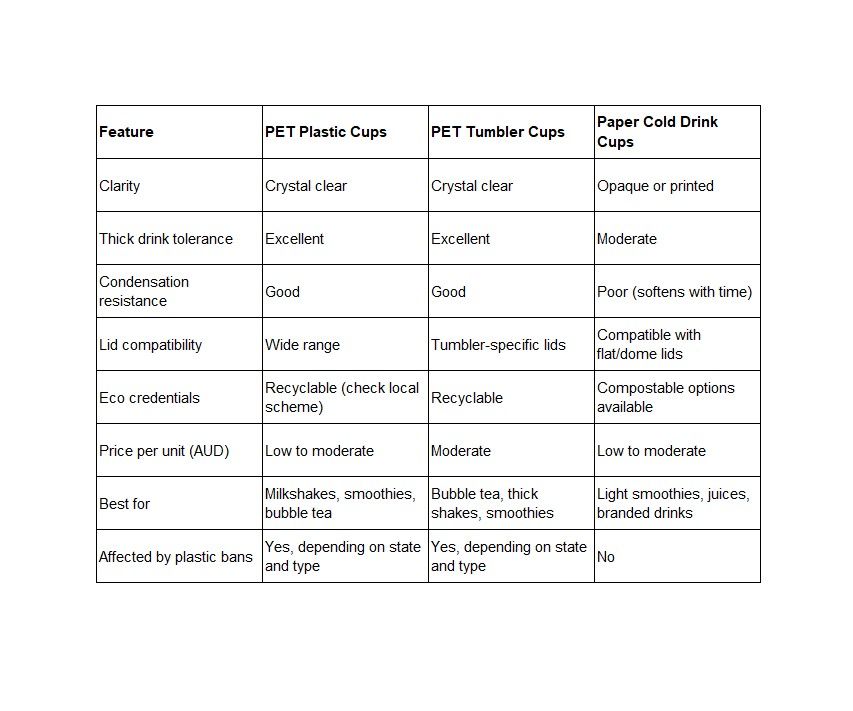
Quick Comparison: Milkshake Cup Materials at a Glance
———————————————
What Makes a Good Milkshake Cup
Before comparing materials, it helps to understand what a milkshake actually demands from its cup. Most disposable cup failures come from underestimating how different a thick shake is from a standard cold drink.
Wall Thickness and Structural Integrity
A standard cold drink cup, the kind you might use for iced coffee or a soft drink, typically has thinner walls designed to hold a liquid that is mostly water. A milkshake is a different product entirely. A well-made thick shake has the viscosity of soft-serve ice cream and can weigh 400-600 grams in a single serve. When you add whipped cream and squeeze a lid onto that, the lateral pressure on the cup walls increases substantially.
Good milkshake cups have walls thick enough to resist buckling when gripped. For PET cups, look for wall gauges of at least 0.3mm. Thinner cups will flex visibly when a customer picks them up, which feels cheap and creates a real risk of the seam splitting if the cup is squeezed.
The base construction matters just as much. A wide, flat base keeps a heavy milkshake stable on a counter. Narrow-based cups that work fine for soft drinks tip over easily when loaded with a dense shake. This is a small detail that costs nothing extra to get right but creates daily frustration if ignored.
Clarity and Presentation
Customers buy with their eyes. A caramel thick shake layered with cream and a biscuit crumble looks extraordinary in a clear PET cup and completely invisible in an opaque paper cup. This is one of the main reasons PET dominates the milkshake category in Australian foodservice, it puts the product on display.
Clarity in PET cups comes from the crystalline structure of the material. High-quality PET cups are genuinely glass-clear, not the foggy or bluish clear you sometimes see in cheaper polypropylene alternatives. If the visual appeal of your drinks is part of your marketing, especially if customers are photographing their orders, material clarity is a commercial decision, not just an aesthetic one.
Condensation Management
Cold drinks sweat. That moisture on the outside of the cup transfers to a customer's hand within seconds, making the cup slippery and cold. PET handles this better than paper because the material itself does not absorb moisture, the condensation sits on the surface rather than being drawn into the wall. A paper cup that gets wet on the outside starts to lose structural integrity within a few minutes, which is a serious problem if the customer is walking around a market, sitting in a car, or carrying the drink any distance.
For dine-in service, this is less critical. For takeaway, the difference between a PET cup and a paper cup in how well it holds up to condensation over 15-20 minutes can be the difference between a good experience and a mess.
———————————————
PET vs Paper vs PLA: Which Material Works Best for Thick Drinks
Three materials dominate the Australian disposable cold cup market in 2026: PET plastic, paper with polyethylene lining, and PLA (polylactic acid) bioplastic. Each has a genuine use case, and each has real limitations.
PET Plastic Cups
PET (polyethylene terephthalate) is the material of choice for milkshakes, and for good reason. It is strong, clear, and does not react with the cold or acidity of dairy-based drinks. The material is rigid enough to hold its shape under pressure and flexible enough not to crack when a customer grips it firmly.
For a high-volume cafe or dessert bar, PET cups are the practical default. They are available in a wide range of sizes, from 12oz to 24oz and beyond, and they are compatible with the broadest range of lids, dome lids, flat lids, and sip-through lids all have PET variants designed to fit the standard cup diameters used across the industry.
From Food Packaging Online's range, the 16oz PET cold drink cup and the 24oz PET cold drink cup are the two most commonly ordered sizes for milkshake applications. The 16oz suits a standard serve and the 24oz handles a large thick shake or a smoothie meal replacement without any structural issues.
The 14oz PET cold drink cup works well for kids' serves or smaller specialty milkshakes at a lower price point, while the 20oz PET cold drink cup fills the gap between medium and large for operators who want a mid-size option.
PET Tumbler Cups
PET tumbler cups are a variation on standard PET cups with a different profile, typically shorter, wider, and with a more robust wall. They are particularly popular for bubble tea because the wider base allows tapioca pearls to settle without clumping, and they handle the thick, straw-demanding consistency of Thai milk tea or taro smoothies without any flex.
Tumbler cups also have a premium visual feel that suits dessert bars and specialty drink shops. The wider diameter creates a different drinking experience, more glass-like, and makes the cup feel more considered than a standard cold drink cup. For operators who want to differentiate on presentation, this is a meaningful upgrade.
Paper Cold Drink Cups
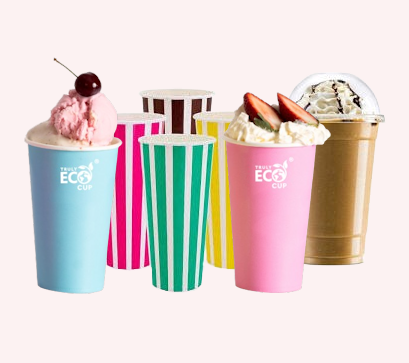
Paper cold drink cups have genuine appeal for brands with strong eco credentials or operators in states where PET cups are facing increasing regulatory pressure. They are also more readily brandable, printing a custom design on paper is significantly cheaper than custom printing on PET.
However, paper cups have real limitations for thick milkshakes. The paper wall, even with a polyethylene or aqueous coating, softens when it makes sustained contact with a very cold, heavy drink. A thick shake that sits in a paper cup for more than 10 minutes will begin to compromise the base integrity. For dine-in service where drinks are consumed quickly, this is rarely a problem. For takeaway or delivery, it is a risk.
Paper cups work well for lighter smoothies, fruit-based blends with a water or juice base, where the drink is less dense and less cold than a dairy milkshake. For juice-forward smoothie bars, paper is a reasonable and commercially responsible choice.
PLA Bioplastic
PLA is made from plant starches (usually corn) and is marketed as compostable. In the right conditions, a commercial composting facility with correct temperature and humidity, PLA does break down. The limitation is that most Australian kerbside recycling and garden waste services do not accept PLA. According to the Australian Packaging Covenant Organisation (APCO), PLA requires industrial composting infrastructure that is not yet widely available across Australian councils.
For most Australian cafe operators, PLA is a niche choice: appropriate if you have a confirmed commercial composting arrangement in your area, but potentially misleading to customers if you are putting PLA cups in a bin that goes to landfill. The eco story needs to be accurate or it becomes a liability.
———————————————
Choosing the Right Size: 12oz to 24oz Mapped to Drink Types
Size selection is where many operators make costly mistakes, either under-sizing and having to overfill cups, or over-sizing and making a small drink look inadequate. Here is how to match cup size to product:
12oz (355mL)
This is the kids' size or the specialty small. If you are doing a single-scoop milkshake for children, a petit smoothie, or a tasting-size bubble tea, 12oz is the appropriate cup. It is rarely used as a standard adult serve in Australian cafes, but it has a place in the size range for operators who want a lower price point option or a kids' meal component.
14oz (415mL)
The 14oz PET cup works well as a regular serve for lighter smoothies or a modest milkshake where you are not piling on toppings. It is popular in gym-adjacent juice bars where portion control matters and the customer wants a defined serve rather than a large drink.
16oz (473mL)
This is the most versatile and most commonly ordered size across the industry. A 16oz cup holds a standard two-scoop milkshake comfortably, with enough headroom for a lid and some whipped cream. It is the go-to for smoothie bars, cafes, and dessert shops across Australia. The 16oz PET cup and the 16oz and 20oz dome lid combo pack are consistently strong sellers for this reason.
20oz (591mL)
The 20oz PET cup sits between medium and large and is popular for meal-replacement smoothies, larger bubble teas, and premium thick shakes where the extra volume justifies a higher price point. Many operators use this as their "large" size when they want to avoid going all the way to 24oz.
24oz (710mL)
The 24oz PET cup is the large or extra-large serve. It is appropriate for thick shakes sold as a meal, for double-serve smoothies, and for operators who want to create a signature oversized drink as part of their brand identity. At this size, structural integrity matters most, a 700mL thick shake is heavy and the cup needs to be robust enough to handle it without flexing.
———————————————
Lid Options: Dome, Flat, Sip-Through, and When to Use Each
The lid is not an afterthought. It determines whether whipped cream survives the trip from counter to table, whether bubble tea pearls get sucked up cleanly, and whether a smoothie stays in the cup during a commute. Get the lid wrong and a good cup becomes useless.
Dome Lids
Dome lids are the correct choice for milkshakes served with whipped cream, toppings, or layered decorations. The dome creates a protective cavity above the rim of the cup that allows toppings to sit undisturbed. Without a dome lid, any topping taller than the rim gets crushed when the lid goes on.
For dessert bars and specialty cafes where presentation is a core part of the product, dome lids with a wide straw hole are the standard. The straw hole should be large enough to accept a wide-bore straw, which is necessary for thick shakes that would collapse a standard thin straw. The 16oz-20oz dome lid combo is a practical option for operators running two cup sizes and wanting to simplify their lid inventory.
Flat Lids
Flat lids work for drinks without toppings, smoothies, plain milkshakes served without whipped cream, or bubble tea where the pearls are entirely within the cup. They create a tighter seal than a dome lid and are better for transport. If a customer is taking their drink in a car or on public transport, a flat lid with a straw hole or sip opening is less likely to let liquid escape if the cup tips.
Sip-Through Lids
Sip-through or sipper lids have a small opening moulded into the lid rather than a straw hole. They are less common for milkshakes but useful for thinner smoothies where a customer does not want to manage a straw. They are not appropriate for bubble tea (the opening is too small for pearls) or for very thick shakes (the drink will not flow through the sip point easily).
Sealing Film (Bubble Tea Applications)
For dedicated bubble tea operations, cup sealing film applied with a sealing machine is increasingly popular. The film creates a completely sealed top that the customer pierces with a pointed straw. This has a distinct theatrical element that has become part of the bubble tea experience, and it prevents any spillage during handoff. If your operation is primarily bubble tea, a cup sealer and compatible film should be on your equipment list alongside the cups.
———————————————
Smoothie Cups and Bubble Tea Cups: Same Cup, Different Application
One question that comes up constantly from operators is whether they can use the same cup for milkshakes, smoothies, and bubble tea. The short answer is yes, PET cold drink cups in the right size work across all three categories. But there are application-specific considerations.
Smoothie Cups
Smoothies are generally less viscous than thick shakes and do not need as much structural rigidity. The priority for smoothie service is a good lid seal (smoothies move freely and will splash if the lid is loose) and a wide enough straw opening. Most PET cold drink cups handle smoothies without any issue. The choice between 16oz and 24oz depends on your serve size and whether the smoothie is positioned as a snack or a meal.
Bubble Tea Cups
Bubble tea has some specific requirements that are worth understanding. The tapioca pearls need space to settle, which means a cup with a wider base is preferable to a very narrow-profile cup. PET tumbler cups with their wider diameter are popular in bubble tea shops for this reason. The straw also matters: bubble tea requires a wide-bore straw (typically 12mm diameter) that can draw up pearls. Standard 8mm straws will not work. Make sure your straw supply matches your bubble tea cup choice.
Bubble tea is also typically sealed rather than lidded in dedicated tea shops, so if you are adding bubble tea to an existing menu and want to seal cups, you will need to confirm that your cup diameter is compatible with your sealing machine. Most sealing machines work with standard 90mm or 95mm diameter cups, but this should be confirmed before ordering in bulk.
———————————————
Bulk Buying Tips for Australian Cafes
For most Australian cafes and takeaway operators, disposable cup costs are a line item that rewards discipline. A 16oz PET cup bought in a case of 50 costs dramatically more per unit than the same cup bought in a case of 1,000. The maths are straightforward: if you are serving 50 milkshakes a day, buying by the sleeve wastes money every single week.
Calculate Your Weekly Usage Before You Order
Count your average weekly milkshake, smoothie, and cold drink serves. Add a 20 percent buffer for unexpected busy periods, a hot weekend, a local event, a social media post that drives foot traffic. That number tells you your safe weekly minimum. Multiply by four to get a monthly requirement and by twelve to get an annual one. Most Australian packaging suppliers have minimum order quantities (MOQs) that make more sense once you are thinking in annual volumes.
Standardise Your Size Range
Every cup size you stock is a separate SKU to manage, a separate space in your storage area, and a separate order line to track. Operators who run three or four cup sizes often discover they could consolidate to two without any customer complaints. The most practical combination for most Australian cafes is a 16oz as the standard serve and a 24oz as the large. Adding a 12oz or 14oz for kids is reasonable if you have a family-oriented menu.
Lid and Straw Compatibility
When buying cups in bulk, always confirm that the lids you plan to use are compatible with the cup diameter you are ordering. Australian cup sizing follows standard diameter conventions, but not all lids are interchangeable across all brands. Order a sample pack before committing to a bulk quantity. The cost of a test order is trivial compared to the cost of discovering a mismatch after 1,000 cups arrive.
For straws, consider pairing your cup order with paper straws to stay ahead of straw bans that are either in place or pending in multiple Australian states. Paper straws have improved significantly in quality and now hold up for the duration of a standard milkshake or smoothie without going soggy, provided they are not left sitting in a liquid for an extended period.
Storage and Shelf Life
PET cups do not have an expiry date in the way that food does, but they should be stored away from direct sunlight and heat. UV exposure over time can yellow clear PET and reduce its structural integrity. A dry, cool storeroom is sufficient. Paper cups should also be kept in a dry environment, moisture in storage can cause cups to warp before they even reach the customer.
———————————————
Australian Regulations: Single-Use Plastics and Your Cold Cup Options
This is the area most Australian cafe operators are understandably confused about in 2026, because the regulatory landscape has changed significantly across different states and territories in the past three years and continues to evolve.
What Has Been Banned
Most Australian states and territories have now banned or are in the process of banning a range of single-use plastic items. The items most commonly targeted include lightweight plastic bags, polystyrene food containers, single-use plastic straws, and plastic cutlery. The specific items and timelines vary by jurisdiction. Queensland, New South Wales, Victoria, Western Australia, and South Australia all have active bans or scheduled phase-outs with different scope and timelines.
For cold drink cups specifically, the current bans in most jurisdictions target expanded polystyrene (EPS) cups, not PET cups. PET cups are not currently banned in any Australian state as of 2026, though they are subject to increasing scrutiny under broader packaging reform agendas.
What Is Coming
The National Plastics Plan and APCO's 2025 targets (now in follow-up implementation phase) set ambitious goals for packaging recyclability and compostability. The direction of travel is clear: packaging that cannot be recycled or composted through existing Australian infrastructure will face increasing regulatory and market pressure. This does not mean PET cups are about to be banned, but it does mean that operators should be thinking about their packaging choices with a medium-term horizon.
For operators in states with active single-use plastic legislation, check your relevant state EPA website for the specific items covered and the effective dates. In Victoria, for example, the Environment Protection Authority Victoria (EPA Victoria) maintains an updated list of banned single-use plastic items. New South Wales operators should refer to the NSW Environment Protection Authority. Each state EPA publishes clear guidance.
Recyclability of PET Cups in Australia
PET is technically recyclable and is accepted by many Australian kerbside recycling programmes, but there is an important nuance: cups are not the same as bottles. Some councils accept PET cups in the yellow recycling bin; others do not. The key variable is whether your local council's recycling contractor can process rigid PET containers that are not bottles. APCO's REDcycle and other industry programmes are working to improve this, but in 2026 the infrastructure is still catching up.
If recycling compliance is a priority for your business, the most defensible position is to provide accurate information to customers about how to dispose of cups in your specific area, rather than making broad recyclability claims that may not apply to your postcode.
FSANZ and Food Contact Materials
Food Standards Australia New Zealand (FSANZ) sets standards for materials that come into contact with food, including beverage cups. PET is an approved food contact material under FSANZ standards. When sourcing cups, confirm that the supplier's product meets Australian food contact requirements. Reputable Australian packaging suppliers will have this documentation available.
The Practical Position for 2026
For most Australian cafes in 2026, PET cups remain a legal, practical, and commercially sensible choice for milkshakes and cold drinks. Paper cups are the alternative for operators who want to move away from plastic, with the understanding that they perform differently with thick drinks. PLA is an option only where genuine composting infrastructure exists. Staying informed about your state's specific regulations and reviewing your packaging choices annually is the responsible approach.
———————————————
FAQs
Can you put milkshakes in paper cups?
Yes, but with caveats. Paper cold drink cups work adequately for lighter milkshakes and smoothies served and consumed quickly. The limitation is that paper cups, even with a PE or aqueous lining, soften when in sustained contact with a very cold, heavy liquid. A dense thick shake sitting in a paper cup for more than 10-15 minutes will begin to compromise the base integrity. For dine-in service where drinks are consumed at the counter, paper is a reasonable option. For takeaway, delivery, or any situation where the cup needs to hold up over time, PET is the more reliable material.
What size cup should I use for a large milkshake?
A 24oz (710mL) PET cup is the standard choice for a large milkshake in the Australian market. It holds a generous pour with room for a lid and toppings without overfilling. If you want a mid-size option between standard and large, a 20oz cup works well. The 16oz is best positioned as a regular or medium serve.
Are PET cups recyclable in Australia?
PET is a recyclable material, but whether your specific PET cups are accepted by kerbside recycling depends on your local council's contracted recycling processor. Some councils accept rigid PET cups in the yellow bin alongside bottles; others do not. Check with your local council or refer to the Australian Packaging Covenant Organisation (APCO) resources for guidance. Avoid making blanket "100% recyclable" claims to customers without confirming your local infrastructure supports it.
What lids work best for thick milkshakes with toppings?
Dome lids are the right choice for milkshakes served with whipped cream, sauces, or toppings. The dome creates clearance above the cup rim so toppings are not crushed. Ensure the dome lid has a wide straw hole, at least 8mm, and ideally 12mm for very thick shakes, so the straw can penetrate without collapsing. For milkshakes without toppings, a flat lid provides a tighter seal that is better for transport.
Do bubble tea cups need to be a specific size or material?
Bubble tea does not have a mandated cup specification under Australian food standards, but there are practical requirements. The cup should be wide enough at the base for tapioca pearls to settle without clumping, PET tumbler cups are popular for this reason. The straw must be wide-bore (12mm diameter is the standard for bubble tea) so pearls can be drawn up. If you plan to seal cups with a sealing machine, confirm your cup diameter (typically 90mm or 95mm) is compatible with the machine before ordering bulk quantities.
What are the minimum order quantities for wholesale milkshake cups in Australia?
Minimum order quantities vary by supplier and product. For most Australian packaging suppliers, cases of 50 or 100 cups per size are the minimum for online ordering, with price breaks at higher quantities (typically 500 and 1,000 units). For operators with sufficient volume, buying at the case or pallet level reduces per-unit cost significantly. Contact your supplier directly for volume pricing and to confirm MOQs on specific products.
Can I use the same cup for milkshakes, smoothies, and bubble tea?
Yes. PET cold drink cups in the right size are suitable for milkshakes, smoothies, and bubble tea. The main variable is lid and straw choice: milkshakes with toppings need dome lids, smoothies without toppings work with flat lids, and bubble tea typically uses wide-bore straws or sealing film. Standardising on one or two cup sizes and varying the lid and straw by drink type is a practical and cost-effective approach for multi-menu operators.
Are plastic milkshake cups banned in Australia?
As of 2026, PET plastic cups used for cold drinks are not banned in any Australian state or territory. Bans are currently focused on EPS (polystyrene) cups, single-use plastic straws, lightweight plastic bags, and plastic cutlery. However, the regulatory environment continues to evolve and varies by state. Operators should check their relevant state EPA website for the most current list of banned items and scheduled phase-outs in their jurisdiction.
———————————————
References
Australian Packaging Covenant Organisation (APCO), APCO publishes annual reports on packaging recyclability, compostability infrastructure in Australia, and the status of the 2025 National Packaging Targets. Their guidance on PLA and PET recyclability is the most current and authoritative source for Australian packaging decisions. Available via the APCO website.
State EPA Single-Use Plastics Legislation Guides, Each Australian state EPA (EPA Victoria, NSW EPA, Queensland Department of Environment and Science, WA Department of Water and Environmental Regulation, SA EPA) publishes updated guidance on banned single-use plastic items, phase-out timelines, and exemptions relevant to food businesses. These are the definitive sources for compliance in each jurisdiction.
Food Standards Australia New Zealand (FSANZ), Food Contact Materials Standard, FSANZ Standard 1.4.3 and related guidance cover materials approved for contact with food and beverages in Australia, including PET, paper, and bioplastics used in disposable cups. Essential reference for operators confirming that their packaging meets Australian food safety requirements.
National Plastics Plan 2021 (Department of Climate Change, Energy, the Environment and Water), The federal government's National Plastics Plan sets out Australia's strategy for reducing plastic waste, including targets relevant to food and beverage packaging. It provides context for the medium-term regulatory direction affecting disposable cup choices.
APCO REDcycle and Packaging Recyclability Evaluation Portal (PREP), APCO's PREP tool allows businesses to assess the recyclability of their packaging formats against Australian kerbside collection infrastructure, providing a practical basis for making and communicating recyclability claims.